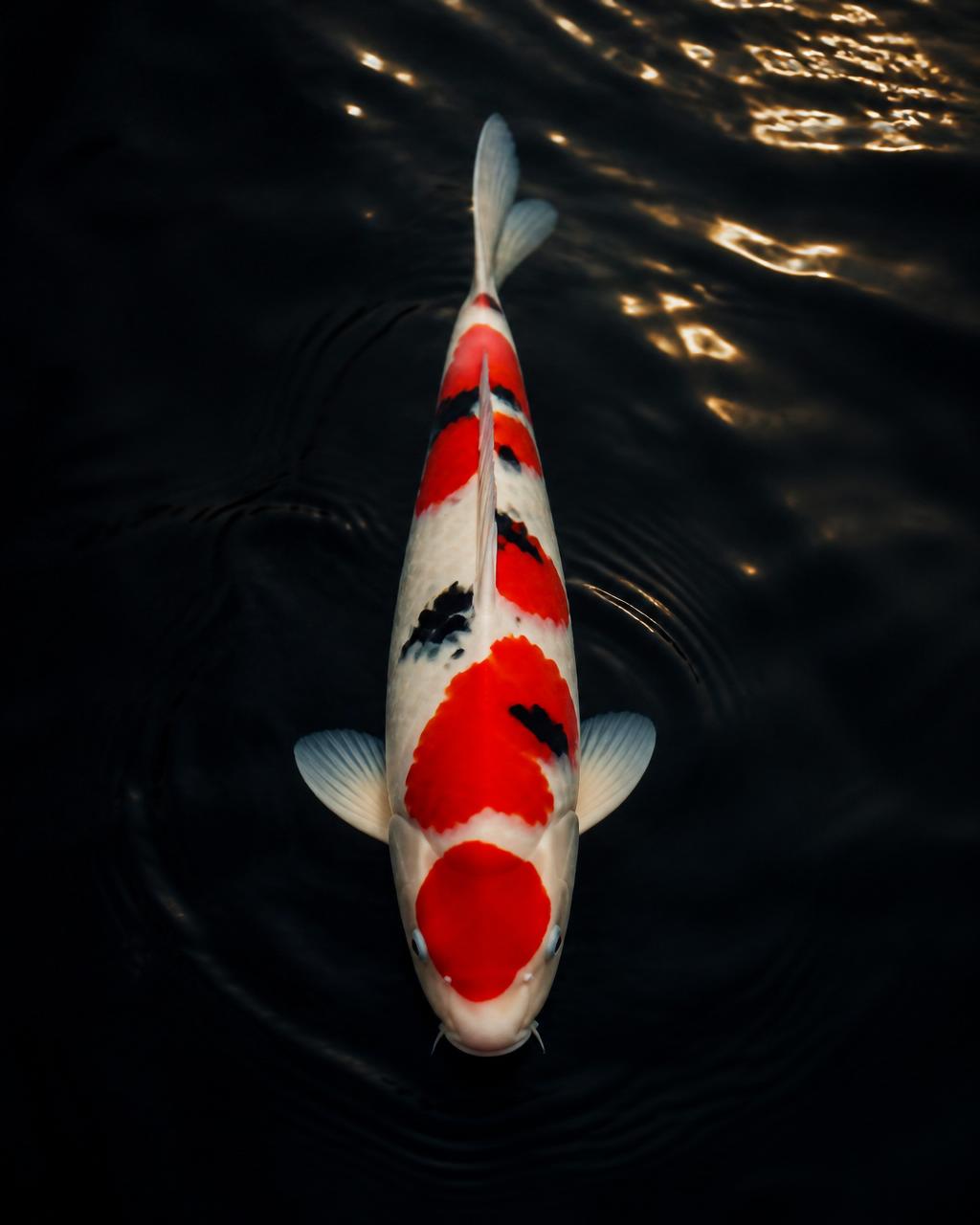
Sanke — properly Taisho Sanshoku — was fixed during the Taisho era (1912-1926) in Niigata. The variety takes a mature Kohaku foundation and adds sumi (black) accents. Modern high-grade Sanke often trace back to Torazo, Sadazo, and Jinbei bloodlines, with contemporary breeders like Momotaro and Dainichi producing exceptional examples.
Reading the sumi
Sumi is the deciding factor in most Sanke judging. Look for tsubo-zumi — sumi sitting on the white ground rather than on top of the hi — and clean, well-defined edges. Sumi on the head is a fault; small sumi accents on the pectoral fins (motoguro) are prized. Sumi often develops slowly over 2-4 years, so a young Sanke's future is read from its skin quality and small emerging spots rather than its current pattern.
Kohaku foundation matters
Because a Sanke is essentially a Kohaku with added sumi, the underlying Kohaku qualities — bright shiroji, deep evenly-edged hi, and a balanced moyo — are non-negotiable. A Sanke with weak hi or dingy shiroji cannot be rescued by good sumi.
Frequently Asked Questions
What is the difference between Sanke and Showa?+
Sanke has a white base with red and black. Showa is a black-based fish with red and white wrapped over it — sumi wraps around the body (maki-zumi) and always appears on the head. A quick test: sumi on the head is Showa, sumi only on the back is Sanke.
Why does Sanke sumi appear and disappear?+
Sumi develops in waves as a Sanke matures. Sub-surface sumi (sashi-zumi) may sit under the skin for a full season before rising and darkening. Patience with young Sanke often rewards owners with a dramatically finished fish by age three or four.
Is Sanke or Kohaku a better first koi?+
Kohaku is easier to evaluate and finish. Sanke is more rewarding once you can read sumi development. If it's your first import, start with Kohaku; add Sanke and Showa as your eye develops.