The Complete Guide to Koi Pond Care in Ontario
Great koi are only as good as the pond that holds them. This guide covers the fundamentals of koi pond care for Ontario and Canadian climates — sizing, filtration, water testing, feeding through the seasons, and the small daily habits that separate ponds where koi thrive from ponds where they only survive.
Pond size, depth, and volume
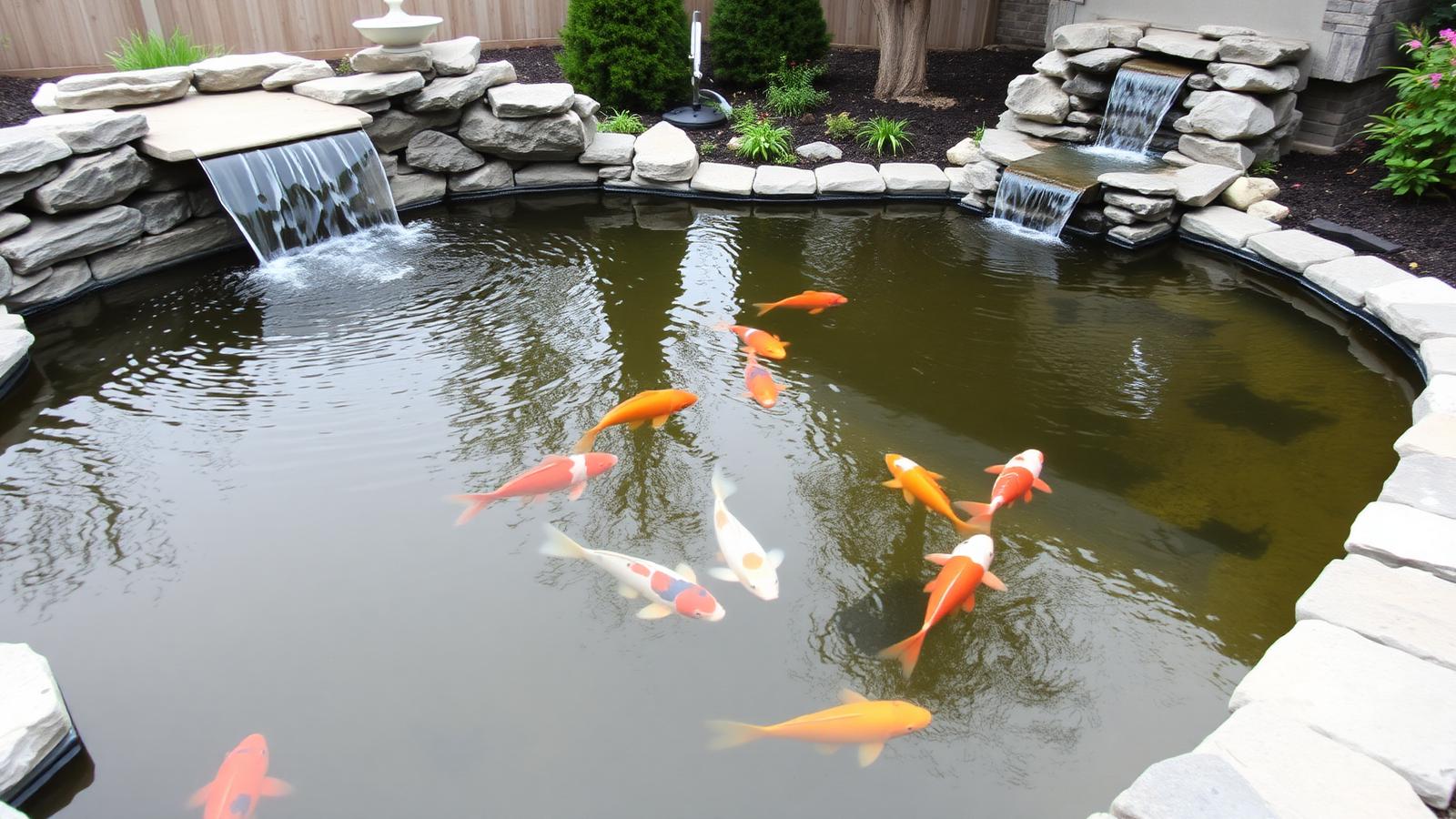
For serious koi keeping in Ontario, plan for a minimum of 1,500 gallons and at least 4 feet of depth. Depth matters more than surface area in a Canadian climate because it protects fish from surface-freezing in winter and from summer temperature swings.
Aim for 250 gallons per adult koi with strong biological filtration and dedicated aeration. Under-sizing filtration is the single most common cause of koi health problems in the GTA.
Filtration and water flow
A koi pond needs both mechanical filtration (to remove solids) and biological filtration (to convert ammonia and nitrite into nitrate). Turn the entire pond volume over every 1–2 hours. Add UV clarification during summer months to control single-cell algae blooms.
Bottom drains and skimmers keep waste moving toward the filter instead of settling in the pond. Aerators should run 24/7 in summer and continue through winter to keep a hole in the ice for gas exchange.
Water testing and parameters
Test weekly: ammonia (target 0 ppm), nitrite (0 ppm), nitrate (<40 ppm), pH (7.4–8.4 and stable), KH (100–200 ppm to buffer pH swings), and temperature. A basic API Master Kit is enough for most hobbyists; serious keepers add a KH test and a digital TDS meter.
The parameter that matters most in Ontario summers is stable pH and adequate KH. Rain events and algae blooms both crash pH quickly if KH is too low.
Feeding by season
Above 18°C water temperature, feed a high-protein growth food 2–3 times a day. Between 10–18°C switch to a wheatgerm-based cooler-water diet once daily. Below 10°C stop feeding entirely — koi digestion effectively shuts down and unprocessed food will foul the pond.
In an Ontario climate, that usually means normal feeding May through late September, transition food through October, and no food from November through April.
Frequently asked questions
- How deep should a koi pond be in Ontario?
- For year-round koi keeping in Ontario, aim for at least 4 feet of pond depth. This keeps water below the freeze line and provides a stable temperature layer where koi overwinter comfortably.
- How often should I feed my koi?
- Feed 2–3 times a day above 18°C, once a day between 10–18°C with a wheatgerm-based food, and stop feeding entirely below 10°C. In Ontario this means feeding May through September, transitioning in October, and no feeding November through April.
- What's the ideal pH for a koi pond?
- Aim for a stable pH between 7.4 and 8.4. Stability matters more than an exact number — swings from rain or algae blooms are harder on koi than a consistent reading a little outside the ideal.